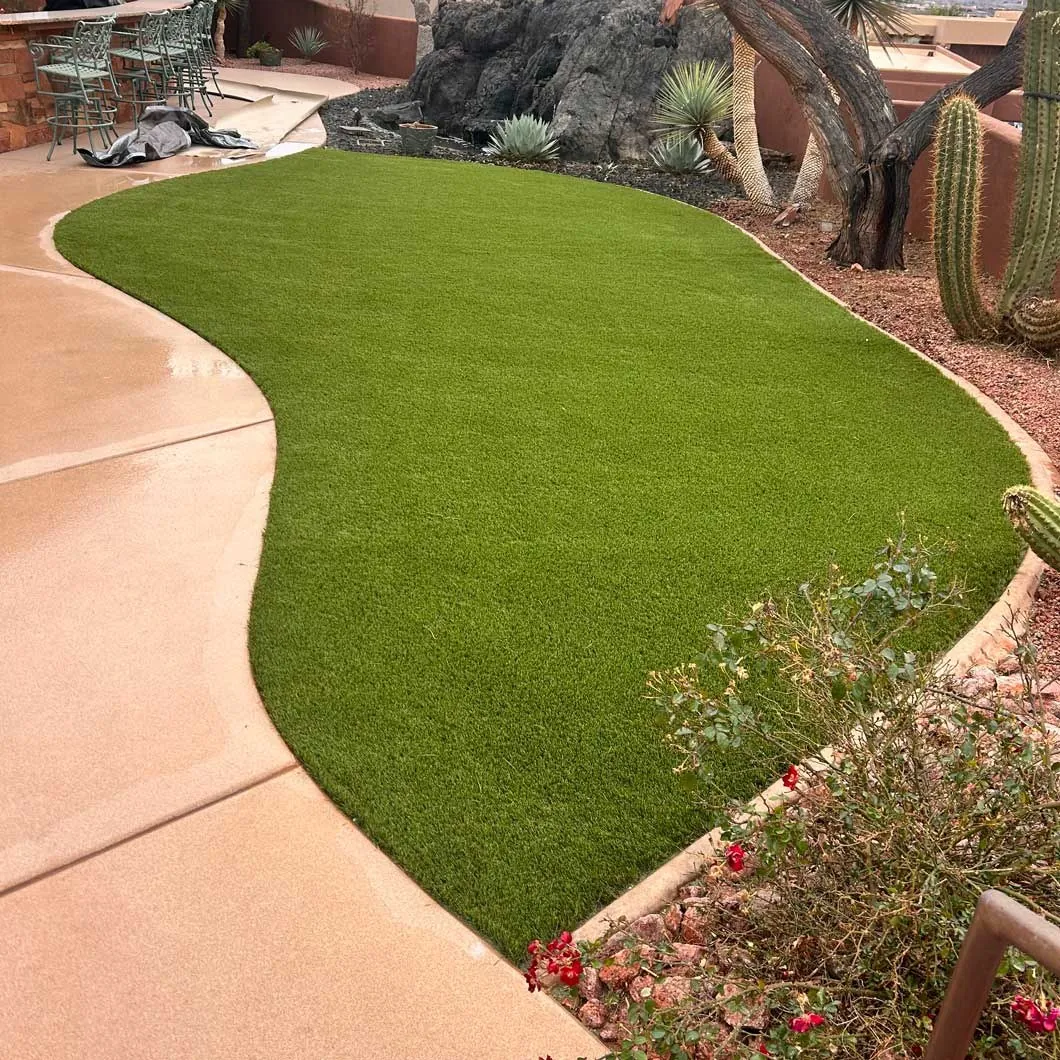
Xeriscape and lawn conversionsDesert landscaping and xeriscape in St. George, UT
Desert landscaping swaps thirsty grass for rock, desert plants and drip lines. Done to the district's rules, it can earn $2 per square foot1. Projects finished June 9, 2026 to June 1, 2027 get a temporary $1 more on the first 1,000 square feet1. True Turf plans the layout, rock and planter areas. Pre-approval comes first.
Last updated · Reviewed by Tate Strickland
Projects are built by True Landscaping & Construction, LLC (dba True Turf). South Utah Turf is an advertising and referral service, not a contractor. How this works
Options
Desert yard layouts that suit the heat
A good desert yard comes down to shade, plant spacing and water that goes only where it's needed. These layouts are a starting point for the free visit.
Full lawn conversion
When it fits: You want the district rebate and to use less water.
Needs 50% living plant cover at maturity, drip irrigation and at least 2 inches of mulch. The converted area goes under a permanent easement1.
Shade-tree layout
When it fits: Hot, sunny yards and west-facing walls.
The district counts each tree as 350 sq ft of plant cover2, and its treebate adds $100 for each qualifying shade tree3.
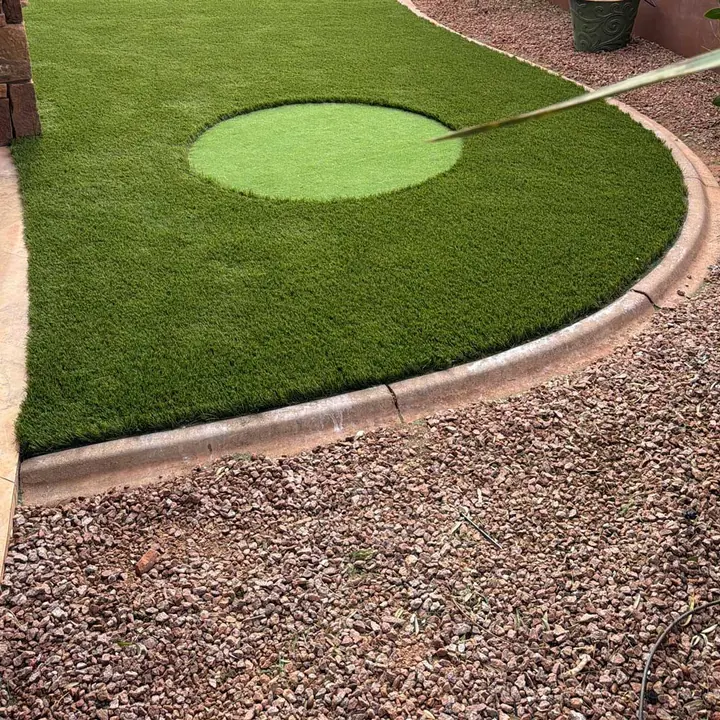
Rock beds with a turf play area
When it fits: Families who still want a green spot to play on.
Permeable turf counts only as mulch, so the converted area still needs its plant cover2. Compare the two in turf vs. xeriscape.
Park strip or side yard
When it fits: Narrow strips that are hard to water well.
The rebate needs at least 300 sq ft of grass. Exemptions may apply when all the grass comes out of a whole area, like a park strip1.
Native desert edge
When it fits: Yards that back onto open desert.
The district allows bare soil where native plants restore an area to native desert1.
Cost
What desert landscaping costs, and what the rebate pays
The water district publishes its own estimate for hiring out a conversion, and its agreement sets the incentive. We checked both in October 2026. For example, a qualifying 1,000 sq ft conversion finished in the bonus window would earn $3,000 before any treebate. The rebate guide covers the fine print.
| Item | Range | Notes |
|---|---|---|
| Conversion by a contractor (rock, plants, drip) | $4 to $6 per sq ft | The district's own estimate2 |
| District incentive | $2 per sq ft | For qualifying converted grass1 |
| Temporary bonus | Plus $1 per sq ft on the first 1,000 sq ft | Projects completed June 9, 2026 to June 1, 20271 |
| Treebate | $100 per qualifying shade tree | Up to one tree per 700 sq ft of conversion3 |
| True Turf's minimum job | $3,000 | The smallest project True Turf takes |
Prices last reviewed October 2026. See how water-wise rebates work.
What moves the price
- Grass removal and haul-off, done only after district approval
- How many plants it takes to reach 50% cover at maturity
- The drip system: dedicated valves, a filter, a pressure regulator and emitters
- Rock or other mulch at least 2 inches deep over the whole area1
- Trees, boulders and planter areas
- Access and slope
How a project works
How a desert landscaping project works
- 1
Call or send a request
Call (435) 660-6207 or use the form. True Turf calls back within 30 minutes during business hours.
- 2
Free on-site consultation
True Turf looks at your yard's sun, slope and drainage, and talks through how you use the space. There's no obligation.
- 3
A plan, a price and the rebate question
You get a layout for rock, plants and planter areas, plus a price. If you want the rebate, apply to the district now and wait for its site visit and approval before any grass comes out2. Ask True Turf who will build the drip system to the district's specs.
- 4
Grading and drainage first
True Turf grades the yard and sets up drainage before rock and plants go in.
- 5
Install and final walkthrough
The rock, planter areas and edging go in, and True Turf walks the finished yard with you.
Local conditions
Rules and conditions for desert yards here
Washington County is the driest county in Utah, according to its water district9. These rules and conditions shape a desert yard that lasts here.
The 50% plant cover math
The district counts each tree as 350 sq ft of cover and each shrub, groundcover or perennial as 35 sq ft, based on mature size2. A 1,000 sq ft conversion needs 500 sq ft of cover, so one tree plus 5 shrubs (350 plus 175) gets you there.
Drip that passes inspection
Drip has to be on dedicated valves with a filter, a pressure regulator and emitters of 20 gallons per hour or less, all visible for inspection1. Any grass left next to the converted area must be at least 8 feet wide, with no spray reaching the conversion1.
Clay soaks up water slowly
Clay takes in water at only 0.01 to 0.5 inches an hour. Water it slowly over a longer time, or the water runs off4. Drip suits that. The district also says to put trees on their own zone, since they need deeper, less frequent water5.
Plants and trees that do well here
Red Hills Desert Garden in St. George shows about 5,000 water-efficient plants with name plates6. The district's top ten shade trees include desert willow, Chinese pistache, chaste tree and fruitless olive7.
Different rules in Cedar City and Enoch
The state program there pays $2 per sq ft and excludes artificial turf. It doesn't count trees toward its 50% cover rule, and it caps drip emitters at 5 gallons per hour8. See Cedar City and Enoch.
Real projects
Projects by True Turf
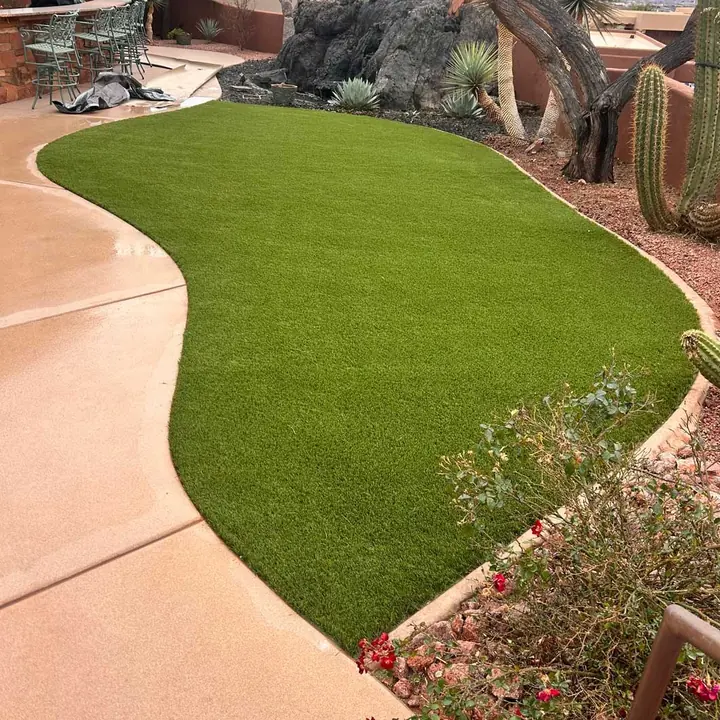
 Turf by the patio
- Concrete curb edging
 Turf and desert plants
How many plants does a rebate conversion need?
Enough to cover half the converted area at maturity. The district counts a tree as 350 square feet and a shrub or groundcover as 35, so one tree equals ten plants2. An 800 square foot conversion needs 400 square feet of cover: one tree plus two shrubs (420) or twelve shrubs (420) would do it.
Can I let my grass die before I apply?
No. The district says Utah law requires living grass to take part, and clearing the area makes you ineligible2. Turning off the water for up to a month before your inspection is usually fine, as long as grass blades are still visible. Apply first, wait for the pre-conversion visit and approval, and only then start.
Do I need weed barrier under the rock?
No. The district doesn't require it and says a few inches of mulch usually keeps weeds down2. If you do use a barrier, it must be permeable, like fabric or mesh. Plastic and other impermeable barriers are prohibited in district conversions1, because they harm soil and plant health2.
Will a desert yard make my house hotter?
Not if you plan shade. The district says shade is the key to keeping cool in the desert, and that shading keeps areas up to 25 degrees cooler2. Its tree guide adds that trees can shave up to 50 degrees off surface temperatures10. Put shade trees where they'll block afternoon sun on the house and patio.
Can I keep my existing trees?
Often, yes. Existing plants can count toward plant cover if they also meet the drip and mulch rules1. Keep heavy equipment off big roots. Put drip lines out under the branch tips, not against the trunk, where a mature tree has few feeder roots10.
How much upkeep does a desert yard need?
Less than grass. In southern Utah, grass usually needs mowing every week in the growing season. Desert landscapes need pruning only once or twice a year, the district says5. Pull weeds while they're small, keep the mulch layer thick, and go easy on fertilizer, since most desert plants need little if any5.
Areas served
Where the installer works
St. George area: St. George, Washington, Santa Clara, Ivins.
Hurricane Valley and the Zion corridor: Hurricane, La Verkin, Toquerville, Leeds, Virgin, Rockville, Springdale, Apple Valley, Hildale.
North county: Dammeron Valley, Veyo, Central, Pine Valley, Enterprise, New Harmony.
Cedar City and Enoch: Cedar City, Enoch.
Next step
Plan your desert landscape
Projects start at $3,000. Call or send the form, and True Turf calls you back within 30 minutes during business hours.
Call the installer(435) 660-6207Projects are built by True Landscaping & Construction, LLC (dba True Turf). South Utah Turf is an advertising and referral service, not a contractor. How this works
Sources and checked dates
- Washington County Water Conservancy District: Water Efficient Landscape Program Agreement wcwcd.gov, checked October 2026
- Washington County Water Conservancy District: Water Efficient Landscape Program FAQ wcwcd.gov, checked October 2026
- Washington County Water Conservancy District: Treebate terms and qualifying trees (PDF) wcwcd.gov, checked October 2026
- Utah State University Extension: Gardening in Clay Soils extension.usu.edu, checked October 2026
- Washington County Water Conservancy District: Water-Efficient Landscaping and Maintenance Tips wcwcd.gov, checked October 2026
- Washington County Water Conservancy District: Water Conservation Gardens wcwcd.gov, checked October 2026
- Washington County Water Conservancy District: Top Ten Most Wanted Trees (PDF) wcwcd.gov, checked October 2026
- Utah Water Savers: Division of Water Resources Landscape Incentive Program details utahwatersavers.com, checked October 2026
- Washington County Water Conservancy District: Water Conservation Achievements wcwcd.gov, checked October 2026
- Washington County Water Conservancy District: Tree Preservation Tips (PDF) wcwcd.gov, checked October 2026