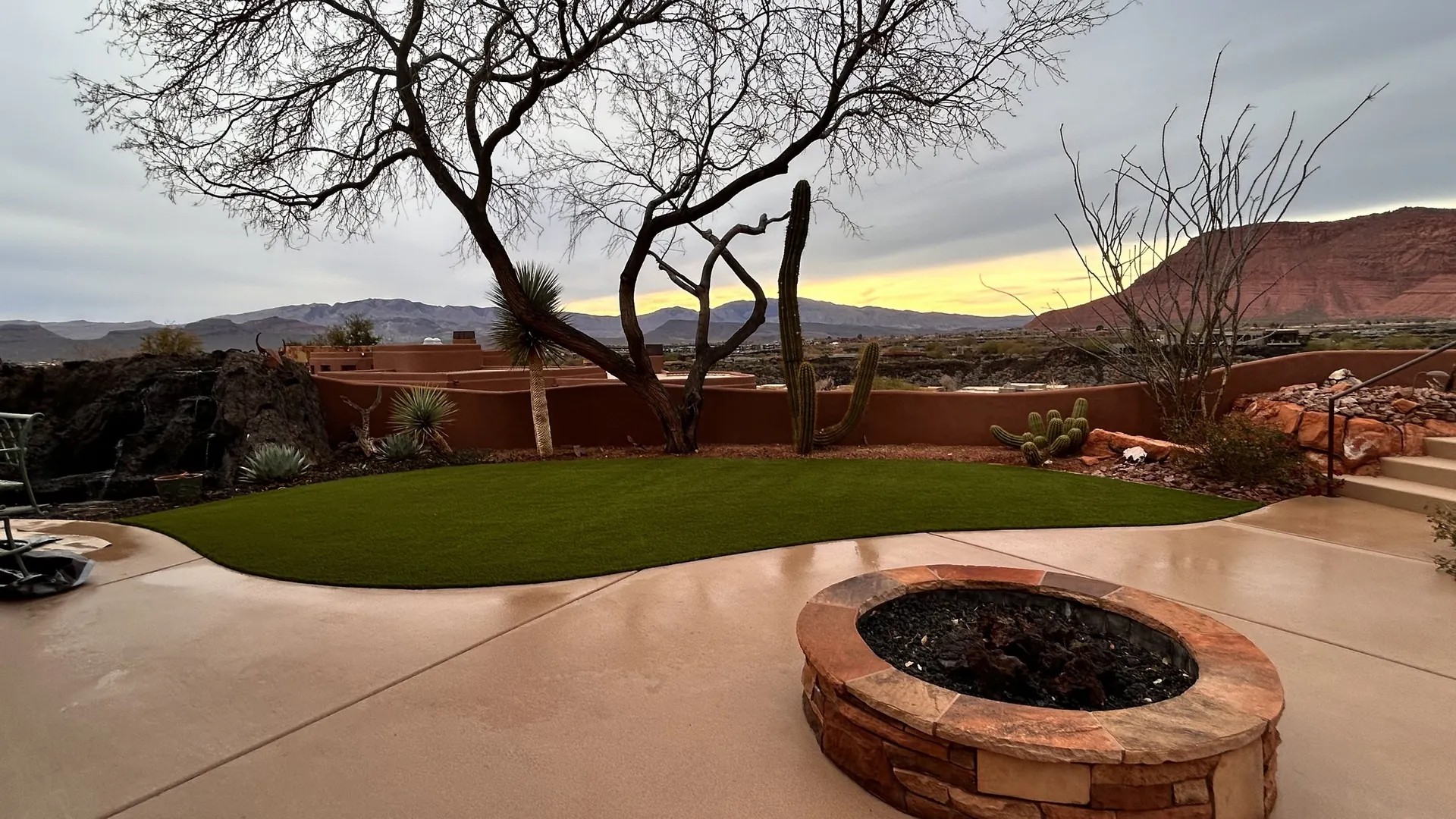
How hot does St. George get in summer?
The St. George weather station's long record, 1893 to 2016, averages a July high of 101.6 degrees and an August high of 99.5. June averages 96.1 and September 92.61. Those are air temperatures. Synthetic turf in full sun runs far hotter than the air around it, as the research below shows.
Get an exact price for your project. True Turf calls you back within 30 minutes during business hours.
Call (435) 660-6207Send the formHow much hotter is turf than real grass?
Penn State's Center for Sports Surface Research says natural grass is commonly 75 to 95 degrees on a hot day and rarely tops 100, while synthetic turf is generally 35 to 55 degrees hotter. The highest published reading it cites is 200 degrees, on a 98 degree day in Provo, Utah2. Most of this research is on sports fields, not backyards.
A 2024 review of 23 studies found synthetic grass surfaces ran 9.4 to 33.7 degrees Celsius hotter than natural grass, which is about 17 to 61 degrees Fahrenheit. The air just above the turf was only 0.5 to 1.2 degrees Celsius warmer3.
Penn State lists the conditions that make surfaces hottest: sunny, clear skies with no clouds, low humidity, and the hours from noon to 3 p.m.2.
Does watering or a cooler infill keep turf cool?
Only for a short time. In one study Penn State cites, 30 minutes of watering dropped turf from 174 to 85 degrees, but it was back to 120 after 5 minutes and 164 after 202. In Penn State's own work, temperatures rebounded 20 minutes after watering, though they stayed about 10 degrees cooler for 3 hours2.
Materials help some. Under a heat lamp, TPE infill ran cooler than black rubber, and white fibers ran cooler than green ones. But in full turf systems after 3 hours, every fiber and infill combination tested landed between about 159 and 171 degrees2. The 2024 review linked TPE infill and cool-climate fibers to lower surface temperatures, but called their wider effect unclear3.
Ask True Turf which turf and infill they suggest for sunny spots, and what to expect from them in July. For the install itself, see artificial turf installation.
Where should turf go in a hot yard?
Put turf where shade falls during the hottest part of the day. The water district says shade keeps areas up to 25 degrees cooler, and it urges water-efficient trees and vines4. Penn State's data puts the hottest hours at noon to 3 p.m.2, so afternoon shade from the house, a wall or a tree does the most for turf.
- Trees on drip add shade, and in a district rebate conversion each tree counts as 350 square feet of plant cover4.
- Rock isn't automatically cooler: Clemson Extension notes gravel and crushed stone reflect solar radiation and can create a very hot landscape in summer5. See landscape rock colors and sizes.
- The district's water efficiency standards allow misting systems from May through September when temperatures exceed 90 degrees6.
- Plan play for mornings and evenings. Penn State's slides cite a BYU guideline of no field use above 120 degrees2.
Is hot turf a safety issue for kids and pets?
It can be. Penn State notes that children are less able to adapt to changes in temperature, and a 1971 study it cites tied hot synthetic surfaces to discomfort, dehydration and a greater chance of heat stroke2. On a summer afternoon, touch the surface with your hand before kids or dogs go out, and give them a shaded spot.
For dog runs, True Turf's published spec is at least 4 inches of compacted base under pet areas. See pet turf for the rest of the build.
When does turf make sense in the heat?
Turf fits the spots you'll actually use, like a play area, a dog run or a putting green, ideally with afternoon shade. For areas nobody walks on, plants on drip with rock mulch can qualify for the district rebate, and turf alone can't4. A mixed plan can do both; compare them in turf vs. xeriscape.
How we checked this
Climate figures come from the Western Regional Climate Center's period-of-record summary for the St. George station (427516), 1893 to 20161. Turf temperature figures come from Penn State's Center for Sports Surface Research presentation on synthetic turf surface temperature2 and a 2024 systematic review in the International Journal of Biometeorology3. Most turf heat research measures sports fields, so treat backyard numbers as a rough guide. We left out turf lifespan and care claims because we found no source we could check. We checked every source on October 21, 2026.